Skip to content

Custom software: business systems, web apps and mobile apps

Business systems and web apps, mobile apps, complex systems. Built around the way you actually work, by one team of engineers: from the first meeting to code in production.

If you are the glue between your programs, the problem is the software.

The Excel export to get what the management system does not cover. The licence you renew every year and use a fifth of. Data copied by hand from one program to another, with the typo you find three weeks later.

These are costs you will not find on an invoice, but you pay them every day.

We start from how you work today and build the software around that work, not around an industry in general.

When does custom software make sense?

It makes sense in two cases: when you do something off-the-shelf products do not cover, or when their rigidity costs you more than the licence saves you.

If your process is standard, a ready-made package is perfectly fine, and we will tell you so. Building makes sense when the way you work is part of your competitive edge: bending it to fit a generic program means throwing it away.

An example: you arrive with three systems that do not talk to each other and one person who spends their days copying data from one to the next. You leave with a single dashboard where that data talks to itself. That is what we did for R&W Tech: 50 welding machines that used to be blind to each other, now read from one dashboard.

What we build

Business systems and web apps

The operational heart of the company, in the browser. Orders, warehouse, production, jobs, reporting: one place where data goes in once and shows up everywhere you need it. Business system and web app are the same thing today: what changes is not the technology, it is how much work runs through it. Ten people in an office and ten thousand simultaneous users are designed differently. We build to measure and make what you already have talk to each other: accounting, CRM, e-commerce, logistics, HR, production machines. For Satispay we built the corporate website on an architecture designed to carry the company's growth and the arrival of new products.

iOS and Android mobile apps

People who work in the field, on the shop floor or in front of a customer do not open a browser: they pick up the phone. They need an app that responds instantly, works where the network does not reach, and does not need a course to use with gloves on. We develop in Flutter: one codebase for iOS and Android, so one thing to maintain instead of two. When needed we go native, where Bluetooth, NFC, sensors and hardware protocols live. The four cases that come up most often, and how we solved them, are below.

Complex systems

Some projects are not an application: they are a system. More software, more machines, more data sources that have to stand up together, often in real time, often with nobody watching. Here the work is not drawing a screen: it is deciding the architecture. Who writes and who reads, what happens when a piece falls over, how it holds when devices go from 50 to 5,000. For IMA the question was whether a machine could handle certain operations: months of embedded software, on paper. We built a proof of concept that gave the answer sooner and with 10% of the resources, cutting research and development costs by 90%.

Business apps, not app store apps

The apps we build are not downloaded because they are handy: they are used because you cannot work without them. The maintenance technician in front of a stopped machine, the engineer inside a warehouse the network does not reach, the sales agent closing an order at the customer's home. The phone here is a work tool, and the app is the mobile piece of a system that already exists: management software, ERP, production data, devices in the field.

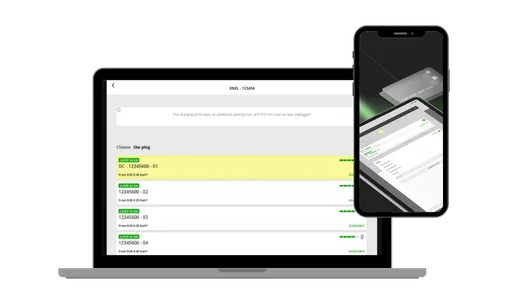
Four cases come up more often than the others. The companion app of a machine or device, which configures and controls it over Bluetooth or NFC: for Assa Abloy we rewrote the Mottura locks app without touching the hardware protocol, so the locks already installed kept working while the app changed completely. The app for field technicians, which has to work offline and sync when the network returns. The app for the sales force, with catalogue, price lists and orders that go straight into the management system instead of passing through a PDF and a phone call. And the app connected to an IoT system, which reads the sensors as the data arrives: for HCube it is a continuous Bluetooth stream from a patch sewn into sportswear, with charts scrolling in real time.

We develop iOS and Android in Flutter: one codebase for two platforms, so one thing to maintain and update at every release. Where cross-platform does not reach we go native, Kotlin and Swift: hardware protocols, Bluetooth Low Energy, NFC, system widgets, Apple Watch apps. It is a matter of arithmetic: two native apps to maintain cost twice as much, forever, and there is almost never a technical reason to justify them.

What we do not do is the consumer app to launch on the stores, the kind that lives on downloads, rankings and retention. That is a different trade, won with marketing more than architecture. If your app has to talk to your processes, your data or your devices, you are in the right place. If it has to win a million private users, you are better off looking elsewhere, and if you ask us we will say so.

Who we build it for

We work with scale-ups and mid-sized and large companies whose process is too specific for ready-made software: manufacturing, logistics, financial services, healthcare, agritech. And with startups that need to go from an idea to a real product, in production, with paying users.

Few clients, a lot of attention: like a boutique, but with modern technology.

The technology, and why these

TypeScript, Next.js and React on the web. Node.js on the backend. Flutter on mobile. Infrastructure on AWS.

These are mature technologies, with large communities and developers you can actually hire. In practice: your software can be maintained and grown by another team too. We do not sell you a padlock.

When stability matters we go with the proven. When there is a concrete advantage we try new paths: IoT, AI and blockchain go into a project because they solve the problem, not because they look good on a slide. What we learn we put back into circulation: our open source projects, such as Multijet and Blaze, are public on GitHub.

  • TypeScript logo
  • Next.js logo
  • React logo
  • Node.js logo
  • Flutter logo
  • Amazon Web Services logo

The bill is paid over the long run

Off-the-shelf software costs little at the start and presents the bill later, in lost hours and stopgap fixes that become permanent. Custom software is an investment that pays back when it stops slowing you down and starts letting you do things your competitors, with the same bought tool, cannot do.

That is why we stay after release. Software lives for years, and in those years people, rules and the market change. We stay to help it evolve: the difference between good custom software and software "made once" shows in the third year, not the first.

WORK

Custom apps and business systems we have built

Frequently asked questions about custom software

FROM THE BLOG

We wrote about it

Have a process that no ready-made software can follow? Tell us about it. Together we will work out whether it is worth building, and how.

Let's talk Back to What we do