bMOTTURA: the smart lock app, rewritten in Flutter
Two native apps became one, without touching the protocol that talks to the locks.

- Year
- 2026
- Design and strategy
- Tangible
- Development
- Quinck
The problem
You use a lock standing in front of a door, shopping bags in hand, with about thirty seconds of patience. It is not the moment for a dropdown menu: either the app opens it straight away, or you have already reached for your keys.
bMOTTURA manages Mottura's smart locks and accessories, and until recently it was the product of a development team left to itself: two separate native applications, Java on Android and Swift on iOS, grown over years without a designer ever touching them. Every feature had to be written twice, the interface had aged, and the flows asked the user to understand how the system works instead of sparing them the thought. Assa Abloy wanted it rebuilt from scratch, with one non-negotiable constraint: the communication protocol with the locks, over Bluetooth and over the API, was not to be touched.
How we solved it
The rewrite is in Flutter, a single codebase for Android and iOS. Where the framework does not reach we went down to native: the system widgets on both platforms and the Apple Watch app are written in Kotlin and Swift, sitting alongside the rest. Tangible redesigned the experience and led the project on the design side. Our part was the least visible and the most delicate: carrying all the functional logic of the old app into a new one, intact.
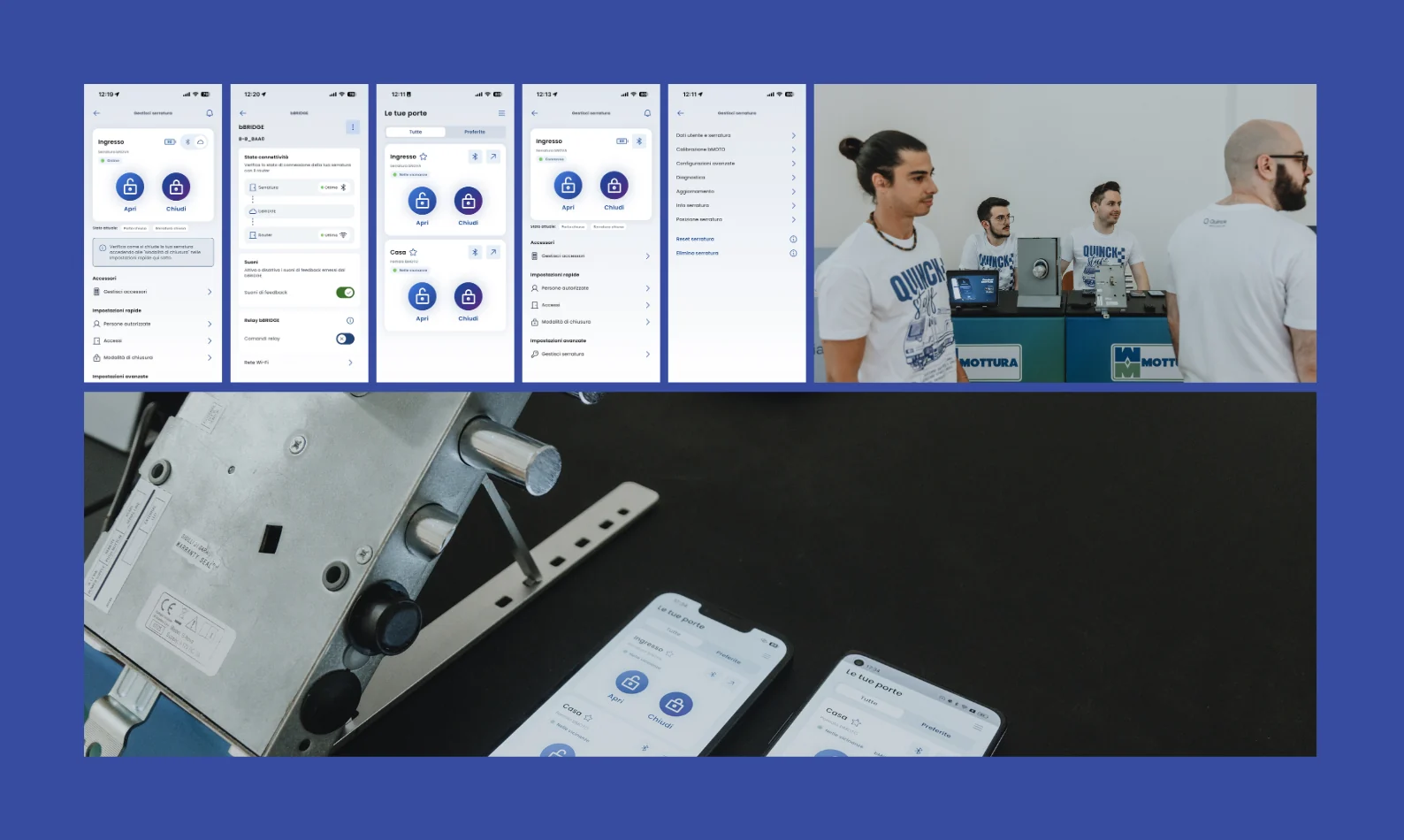
Rewrite everything above without moving a comma below.
The part you notice least is the part that works best. Within range of the lock the app talks to it directly over Bluetooth Low Energy, and the door opens even if the phone has no signal. Away from home the commands go through the bBRIDGE, the device on the home Wi-Fi that turns them back into Bluetooth at the door on your behalf. The app tries the BLE scan first and, if the lock does not answer, moves to the cloud by itself: there is no switch to flip and no mode to choose.
Around this sits everything else: guests invited with their own access, keypads, fingerprint readers and NFC cards to pair, diagnostics, and full localisation into the languages of the markets where the products are sold. The result is an app that is updated once and arrives identical on both operating systems, and that asks the person at the door to do one thing: press.
A Flutter mobile app for Android and iOS, with native Kotlin and Swift where the cross-platform framework does not reach: the system widgets on both platforms and the companion Apple Watch app. A React and Tailwind web front end for operations that go through the cloud. UI and prototyping in Figma by Tangible. The delicate part was the conversation with the hardware: the protocol to the locks, Bluetooth Low Energy up close and cloud APIs through the bBRIDGE when the user is away, was already implemented and could not be modified, and had to be preserved with full compatibility for every device already installed. Translations are built into the development flow, with Italian as the reference language from which all the others derive.
A Flutter mobile app for Android and iOS, with native Kotlin and Swift where the cross-platform framework does not reach: the system widgets on both platforms and the companion Apple Watch app. A React and Tailwind web front end for operations that go through the cloud. UI and prototyping in Figma by Tangible. The delicate part was the conversation with the hardware: the protocol to the locks, Bluetooth Low Energy up close and cloud APIs through the bBRIDGE when the user is away, was already implemented and could not be modified, and had to be preserved with full compatibility for every device already installed. Translations are built into the development flow, with Italian as the reference language from which all the others derive.
- Year
- 2026
- Design and strategy
- Tangible
- Development
- Quinck
Got something similar in mind?
Tell us what you want to build and we will help you find the shortest way there.