Shape-Up: exercise written as a medical prescription
An app for the patient and a back office for the doctor: aerobic training tuned to real heart rate.

- Year
- 2025
The problem
In a family doctor's practice, hypertension, diabetes and anxiety or depression walk in every day. Davide Becchetti had started answering with exercise as well: aerobic programmes on a bike, running or walking, built around the individual patient. The limit was not clinical but practical: progress came back self-reported, and the planning lived in Excel sheets filled in by hand, one per patient.
How we solved it
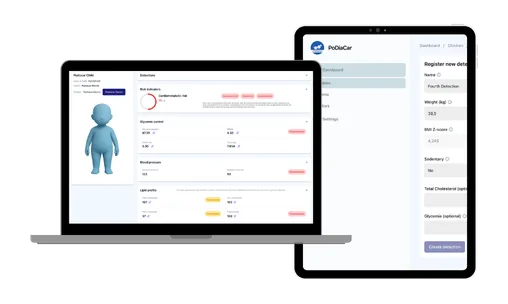
We built two products that talk to each other. On the patient's phone, a Flutter app for Android and iOS: registration, pairing with the heart rate strap, the sessions to perform and articles matched to their own condition. On the doctor's side, a React and Next.js back office on serverless AWS infrastructure, where the recorded data becomes the basis for planning the next sessions.
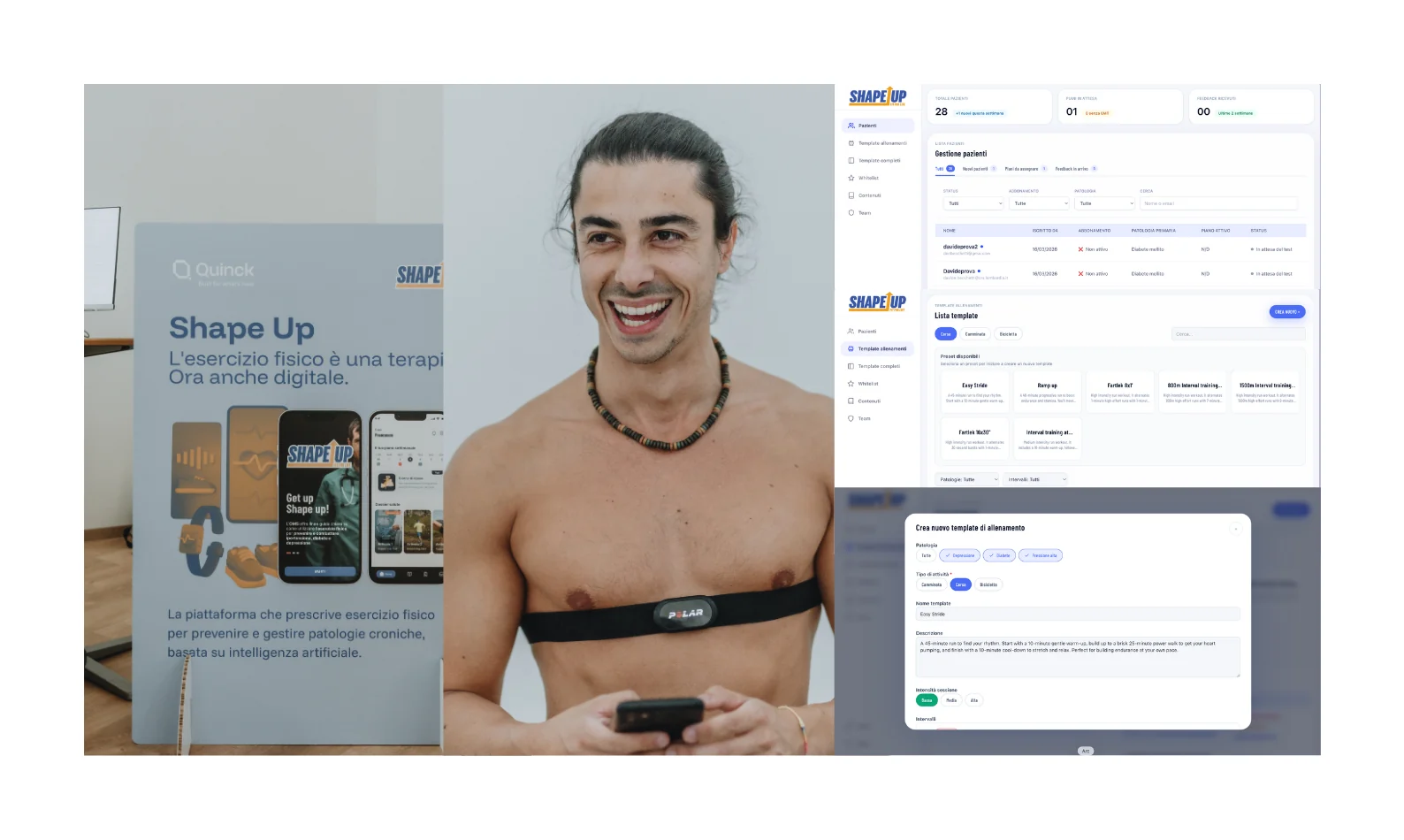
It starts with the six-minute test, the same one used to assess aerobic endurance in athletes. The heart rate profile, average speed and distance covered arrive in the back office, where the doctor sets the patient's heart rate thresholds and divides them into zones: warm-up, fat burning, aerobic. Every session that follows is built around those numbers.
Once the subscription is in place, the doctor schedules sessions around the days that suit the patient. They can start from ready-made templates, inherit them from another programme and adapt them, or design a progression from scratch: warm-up, fat burning, intervals, cool-down, each with a time or distance target and a minimum and maximum heart rate to stay within.
During the session the patient does not look at the screen. A voice assistant announces the start and end of each phase, and audio cues bring them back into the intended heart rate zone whenever they drift out of it. It is the part that turns a written programme into a session performed the way the doctor intended.
At the end of the week the patient shares their clinical parameters, which differ by condition: blood pressure readings, fasting blood glucose, or the PHQ-9 questionnaire, an already validated instrument. The doctor reads them alongside the sessions actually completed and decides whether the progression is working or needs recalibrating. All handling of health data is GDPR compliant.
The results
The result is a change of scale. Self-reported data is replaced by a recorded cardiac profile, manual planning by reusable templates, and the number of patients a single doctor can keep in follow-up grows accordingly. The platform is built to take on other clinicians who share the same method.
A Flutter mobile app for Android and iOS, with a native SDK integrated on both platforms for Bluetooth pairing with practically any heart rate strap on the market: the most delicate piece technically. The web back office is React and Next.js in TypeScript with Tailwind, the backend Node.js with the Hono framework, all on AWS serverless: Lambda and API Gateway through SAM, RDS PostgreSQL, S3, Secrets Manager, EventBridge, hosted on AWS Amplify. Because this is health data, the whole platform is GDPR compliant, with the app-to-web synchronisation extracting data in a way that respects patient privacy.
Stack: Flutter, SDK nativo Android/iOS, React, Next.js, TypeScript, Node.js, Hono, AWS Lambda, Amazon RDS, AWS Amplify
- Year
- 2025
Got something similar in mind?
Tell us what you want to build and we will help you find the shortest way there.