Tulsy: the marketplace that brings order to SaaS tools
One place to discover software, licences and online tools. Built half in code, half with AI.

- Year
- 2026
- Design and development
- Quinck
The problem
Looking for a SaaS tool today means opening twelve tabs: a Reddit thread from 2022, a comparison article that is actually affiliate marketing, three videos on YouTube, somebody's pricing page that has changed plans since. In the end you pick the tool that communicates best, not the one you need.
Tulsy starts from the other side of that problem. Davide Longo had seen the same scattering from two points of view that usually do not talk to each other: users losing time across fragmented sources, and companies paying for that time in visibility they never get. Not another review site, but a single place where the demand for and supply of software genuinely meet: whoever is searching stays focused, whoever is selling has a shop window.
How we solved it
The portal holds three roles together, with different views and permissions. The user registers, searches by keyword (every search crosses tags, titles and descriptions), filters by category, saves favourites, leaves reviews and then goes out to the official site to subscribe: Tulsy does not hold on to the transaction, it points it somewhere. The company registers itself, uploads one or more products, pays a subscription for each in the platform, reads reporting on clicks and traffic generated, and can ask for advice on dedicated promotions. The admin sits in between: approving applications, asking for additions, rejecting, and watching high-level statistics on what people are actually searching for.
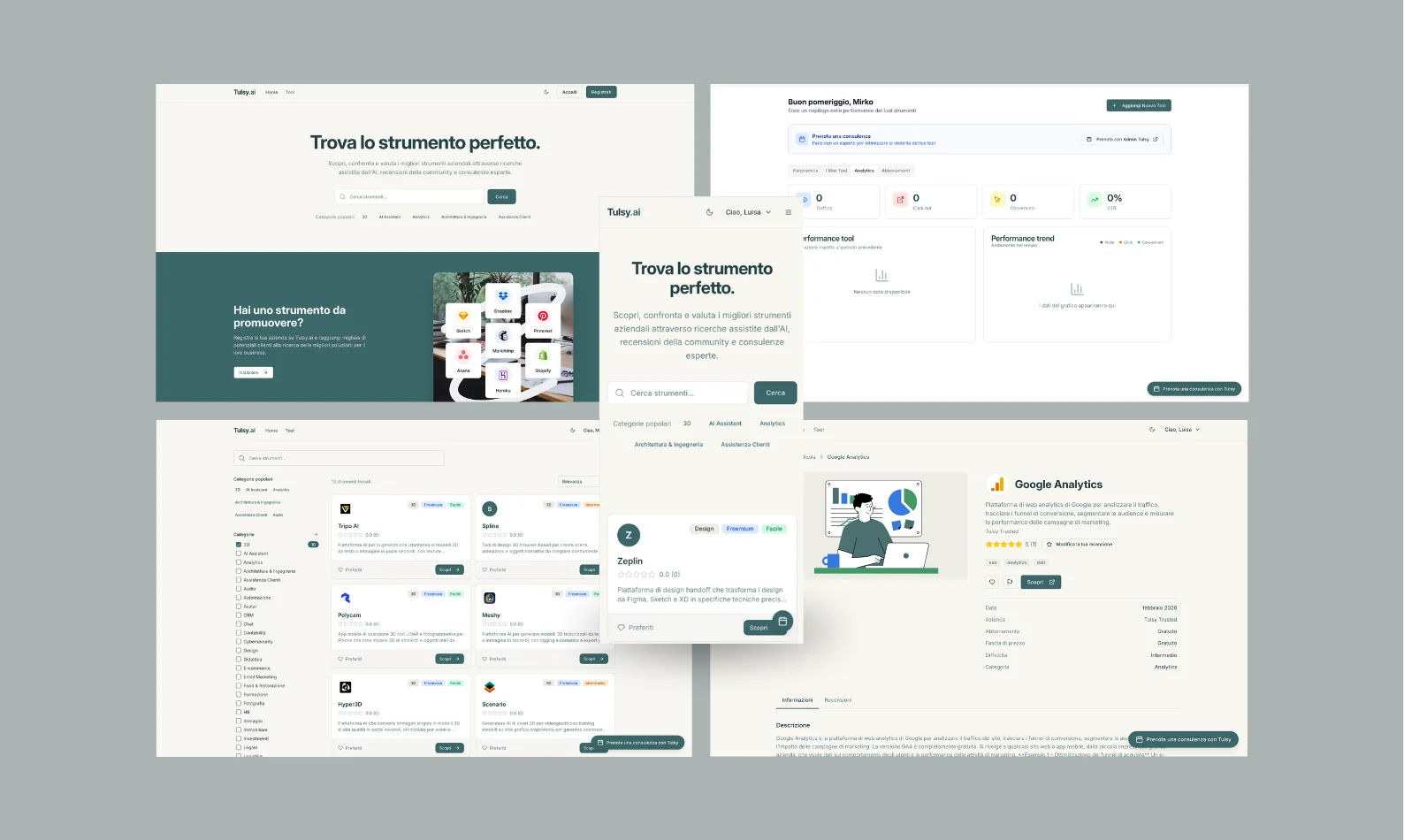
Underneath there is React 19 with Vite 7 and Tailwind CSS v4 on the front end, a Hono backend with Zod OpenAPI, PostgreSQL with Drizzle ORM. The choice that matters, though, is not in that list: typed API contracts and a data schema declared in one place are exactly what prototypes thrown together quickly lack, and they are the point where those prototypes break when the twentieth feature arrives.
The prototype is the easy part. It is the last thirty per cent that decides whether you launch.
That is why Tulsy was built half in code and half with AI, and in that order for a reason. The work on Replit covered ground quickly where the problem was well understood: views, forms, scaffolding. The hand-written work went where the product has to hold up over time: the data model, the contracts, the approval flows, the payments. The result is not a prototype that grew badly, it is an MVP that can be maintained.
And an MVP is not half a product: it is a product cut back to the question it has to answer. Here the question is whether companies are willing to pay to be in this window. Subscriptions, reporting and moderation are in the platform from day one, so the answer comes from the market rather than from a slide.
A React 19 front end with Vite 7 and Tailwind CSS v4; a Hono backend on Node.js with Zod OpenAPI for typed API contracts; PostgreSQL with Drizzle ORM. The interesting part is the method: Tulsy came out of a hybrid approach, mixing hand-written code with work on Replit, arriving at a complete, working product without having to choose between speed and solidity.
Stack: React 19, Vite 7, Tailwind CSS v4, Hono (Node.js), Zod OpenAPI, PostgreSQL, Drizzle ORM, Hybrid build: hand-written code and Replit
- Year
- 2026
- Design and development
- Quinck
Got something similar in mind?
Tell us what you want to build and we will help you find the shortest way there.