Innovation Tracker: measuring internal innovation, not describing it
One innovation manager's method turned into a platform, repeatable and dependable in the hands of people who did not invent it.

- Year
- 2026
- Client
- Clover Venture
- Development
- Quinck
The problem
A consulting method that works has a problem that sounds like a compliment: it works because one particular person applies it. Whoever runs innovation inside companies builds bespoke engagements, and that bespoke quality lives in spreadsheets, questionnaires put together by hand and qualitative readings worth exactly as much as the experience of whoever wrote them. The day the service has to become something licensed to other professionals, that method has to come out of the consultant's head and go into a product.
How we solved it
The first piece is onboarding the company, and it is not paperwork: it is the fuel for the AI. A wizard collects the company profile, the business unit structure, the people and the strategic context, meaning the phase of transformation, the goals, the constraints and the changes already attempted. The fuller that profile, the more the surveys and analysis that follow are cut for that company rather than for an average company that does not exist.
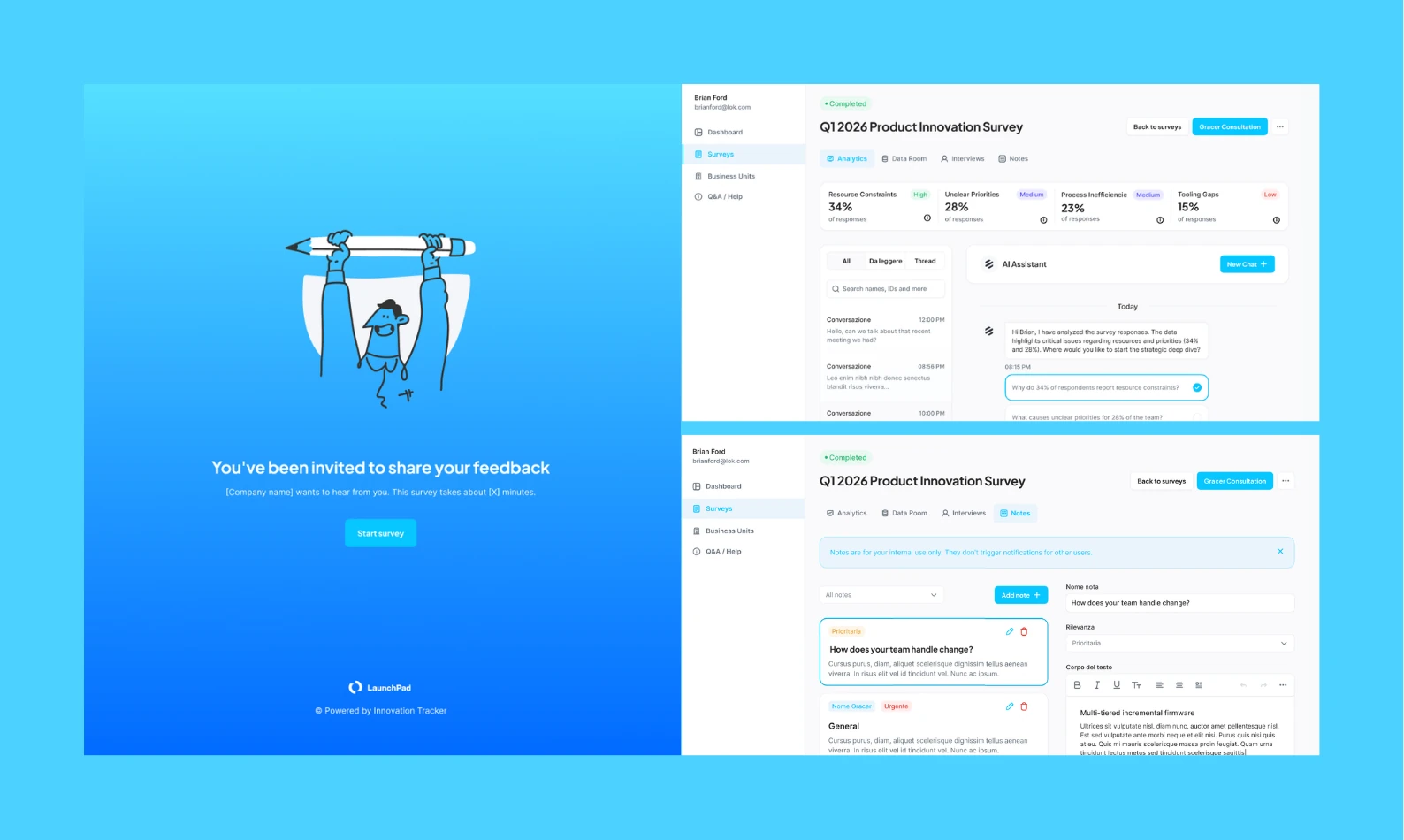
Then comes the questionnaire, which is where comparability is won or lost. There are three routes: start from the templates validated by Grace, the Clover Venture product that supplies both templates and consultants, which is the recommended route because it makes results comparable across companies and over time; have the AI generate one from the context and the documents uploaded; or build one by hand. Inside the builder an agent flags leading or ambiguous questions inline, the ones that produce unusable answers, and respondents are proposed from the business units involved rather than hunted down by hand.
On the answering side we removed everything that could be removed. No account: you arrive from a magic link by email, choose whether to stay anonymous or sign your name, fill it in from a phone if you like, and answers save as you write. These are the details that decide the participation rate, and the participation rate decides whether the data is worth anything.
Once a survey closes, analysis stops being a reading exercise. A panel summarises sentiment, recurring themes, engagement and suggested actions, always tied back to the context gathered at setup, and a chatbot scoped to that survey's data lets you question the answers in plain language instead of through a filter. The detail on any single question is always one click away, because a machine's summary does not replace a person's answer.
From there the engagement continues: interview campaigns with respondents, shared notes and consultations bookable in the calendar with the Gracer, the Grace consultant assigned to that company, who works alongside the innovation manager without replacing them. At the end sits the Data Room, where the deliverables land. A report can start as an AI-generated draft built from answers, notes, interviews and consultations, or from a template, and is published to respondents with one click. Whoever governs the service, on the other side, sees companies, licences, assignments and consultant workload from a single console: when a licence expires the company moves to read-only and the data stays.
The part we are proudest of is the part you cannot see: the infrastructure. Serverless on AWS, with cost following actual usage instead of a server sitting switched on waiting for users. For an MVP that has to prove a business model before scaling it, that is the right shape, and the day the user base grows you migrate to something sturdier without redesigning from scratch. The same logic as the decision not to put a RAG where a structured context was enough: the architecture is sized for today's problem, leaving tomorrow's door open.
Serverless AWS infrastructure: Lambda, API Gateway, a managed database and S3 storage, sized for an MVP whose cost follows usage and built to scale or migrate as the user base grows. The AI goes through OpenAI's GPT APIs to generate questions, review surveys, produce analysis, answer in the chatbot and draft reports. No RAG architecture at MVP stage: that is a choice, not an omission, because the context the model needs is structured and bounded (company setup, answers, notes) and a retrieval layer would have added complexity without adding answers. A backend with role-based permissions, magic links for respondents, progressive saving and email notifications. A responsive front end with a single design system across all profiles, prototyped in Figma.
Serverless AWS infrastructure: Lambda, API Gateway, a managed database and S3 storage, sized for an MVP whose cost follows usage and built to scale or migrate as the user base grows. The AI goes through OpenAI's GPT APIs to generate questions, review surveys, produce analysis, answer in the chatbot and draft reports. No RAG architecture at MVP stage: that is a choice, not an omission, because the context the model needs is structured and bounded (company setup, answers, notes) and a retrieval layer would have added complexity without adding answers. A backend with role-based permissions, magic links for respondents, progressive saving and email notifications. A responsive front end with a single design system across all profiles, prototyped in Figma.
- Year
- 2026
- Client
- Clover Venture
- Development
- Quinck
Got something similar in mind?
Tell us what you want to build and we will help you find the shortest way there.