PoDiaCar: the digital twin that sees risk coming
Eight cardiometabolic indicators estimated by a predictive model, and a 3D avatar that shows how risk moves over time.

- Year
- 2025
- Project
- PoDiaCar
- Scientific coordination
- Ospedale dei Bambini Buzzi, ASST Fatebenefratelli-Sacco, Milano
- Research partners
- Università di Pavia, Universidad de Granada, Asomi College of Sciences, LUNEX University
- Funding
- Unione Europea, Grant Agreement n. 101128946
- Publication
- European Journal of Pediatrics, gennaio 2026
- Development
- Quinck
The problem
In paediatric cardiometabolic monitoring there are many parameters to watch: blood pressure, BMI, lipid profile, blood glucose. They are usually read visit by visit, with the derived values worked out by hand or on separate tools. The trend over time goes unseen, and a wrong formula is always one step away.
How we solved it
PoDiaCar gathers it all in one place and automates the arithmetic. From the data the clinician enters, a machine learning model estimates eight cardiometabolic indicators: the ones not measured are predicted rather than left blank. At every new reading the profile updates and the clinical panels, for cardiometabolic risk, glycaemic control, lipid profile and blood pressure, are recalculated against the most recent visit.
The patient is represented by a digital twin: a 3D avatar of the child that shows at a glance how the indicators are moving, with red badges on pathological findings and amber ones on those to keep watching. A still photograph becomes a trajectory, which in prevention is the information that matters.
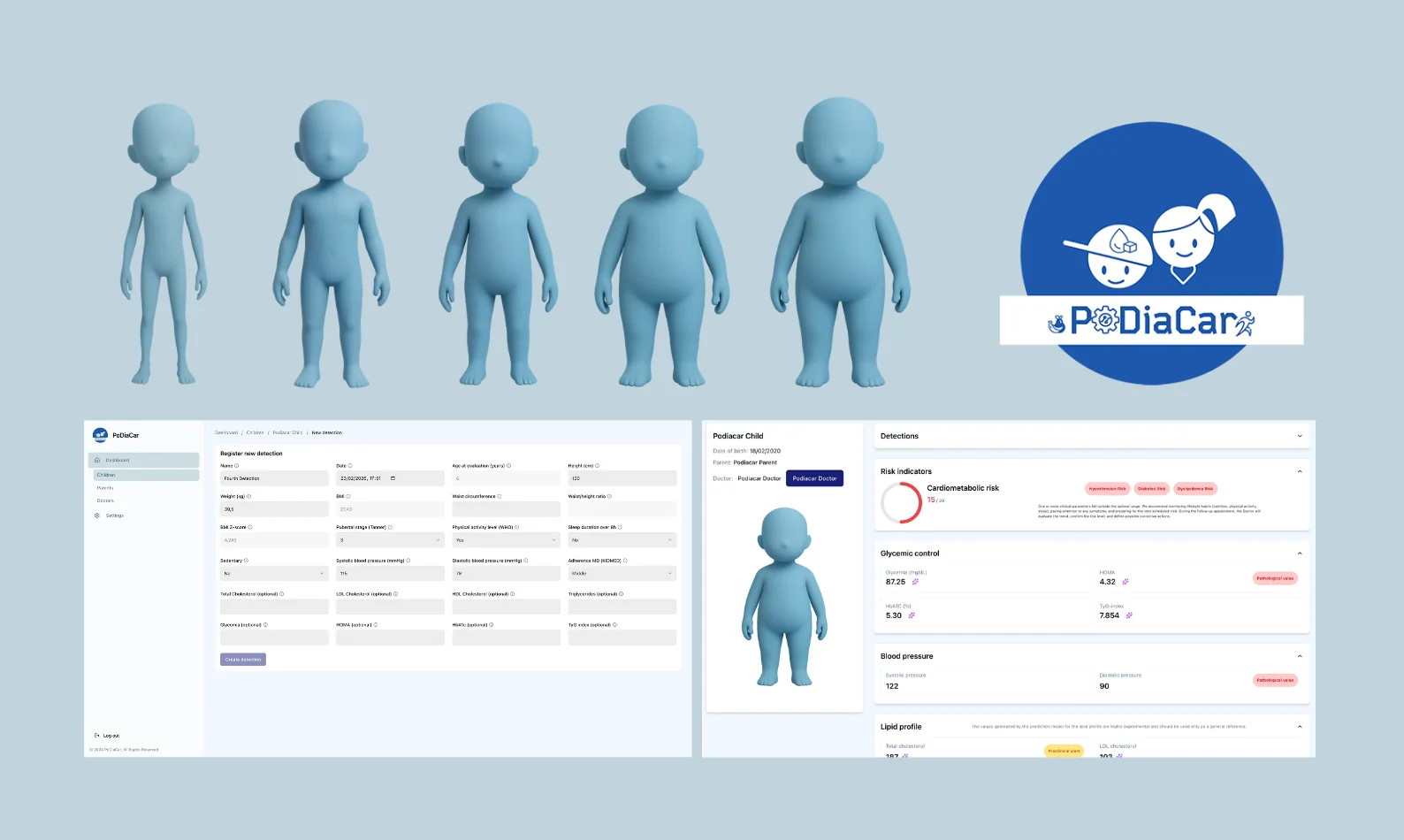
The platform does not decide in the clinician's place: it gives them firmer ground to decide on.
Three roles revolve around the patient, each with its own permissions. The administrator creates the entities and configures consent between the parties. The clinician records readings for the patients assigned to them and runs the longitudinal follow-up. The parent consults their child's clinical history and medical background, without being able to enter data.
The model works on three indicators by regression (systolic and diastolic blood pressure, insulin) and five by binary classification (blood glucose, pathological blood pressure, HOMA-IR, TyG index, HbA1c). Ridge, Lasso, SVM, Random Forest, Gradient Boosting and KNN were compared under cross-validation: for each indicator, the algorithm that best balances accuracy against clinical interpretability is the one that goes into production.
Because this is health data about minors, the infrastructure is part of the product rather than a backdrop: AWS described in Terraform, development and production environments kept apart, controlled releases through GitHub Actions, encryption, MFA, patient anonymisation and operation logging in CloudWatch, on a privacy-by-design footing.
The results
For the clinicians in the pilot the gain is concrete: no indicator to calculate by hand, and therefore no derived arithmetic errors; visits recorded in a structured form rather than on paper; and the ability to follow far more patients over time than a manual follow-up can carry.
The platform has made it into the literature: in January 2026 the European Journal of Pediatrics published the paper describing its architecture, models and performance. Which is not uniform, and that is a useful finding: excellent on the TyG index, solid on HbA1c, still limited on blood pressure and blood glucose, where a richer dataset is needed. A clinical digital twin is judged indicator by indicator, not by slogan.
A React and Next.js front end, a Node.js backend with APIs structured for scale and maintenance, and a PostgreSQL relational database. The machine learning model is in Python with scikit-learn, combining regression and classification algorithms chosen through comparative testing and cross-validation to balance accuracy against clinical interpretability. Because this is health data, the AWS infrastructure was designed with separate development, test and production environments, controlled releases and configuration through Terraform, with distinct roles (clinician, parent, administrator) and operation logging.
Stack: Python, scikit-learn, React, Next.js, TypeScript, Node.js, Hono, PostgreSQL, Drizzle ORM, AWS Lambda, Terraform, GitHub Actions
- Year
- 2025
- Project
- PoDiaCar
- Scientific coordination
- Ospedale dei Bambini Buzzi, ASST Fatebenefratelli-Sacco, Milano
- Research partners
- Università di Pavia, Universidad de Granada, Asomi College of Sciences, LUNEX University
- Funding
- Unione Europea, Grant Agreement n. 101128946
- Publication
- European Journal of Pediatrics, gennaio 2026
- Development
- Quinck
Got something similar in mind?
Tell us what you want to build and we will help you find the shortest way there.