Operator manuals: AI writes the draft, the technical writer reviews it
A proof of concept to find out whether AI can write a machine's operator manual from the screen alone. The answer is yes, as a draft to review.
- Year
- 2026
- Client
- Italian industrial group, manufacturer of machinery and plants
The operator manual, a bottleneck at the end of the project
An operator manual tells the person running a machine what every value on the screen means: what they set and what they only read, in which unit, and what changes from one machine model to the next. Writing it well takes knowing the machine and following a precise style, and with every software release the work starts over.
So documentation becomes the last step before delivery, and therefore the one that makes it slip. The client's idea was to change the job, not the people: the technical writer stops writing from scratch and starts reviewing a draft.
Can AI write a technical manual?
A language model writes plausible text about almost anything. The point is whether it writes the right text: in an operator manual a wrong title or an invented unit of measure is not a matter of style. That is why the proof of concept had a tight constraint and a measurable goal. The constraint: no access to the interface code, only the image of the screen and the file the design software exports. The goal: compare every draft with the published manual, field by field, to know how close it gets instead of guessing.
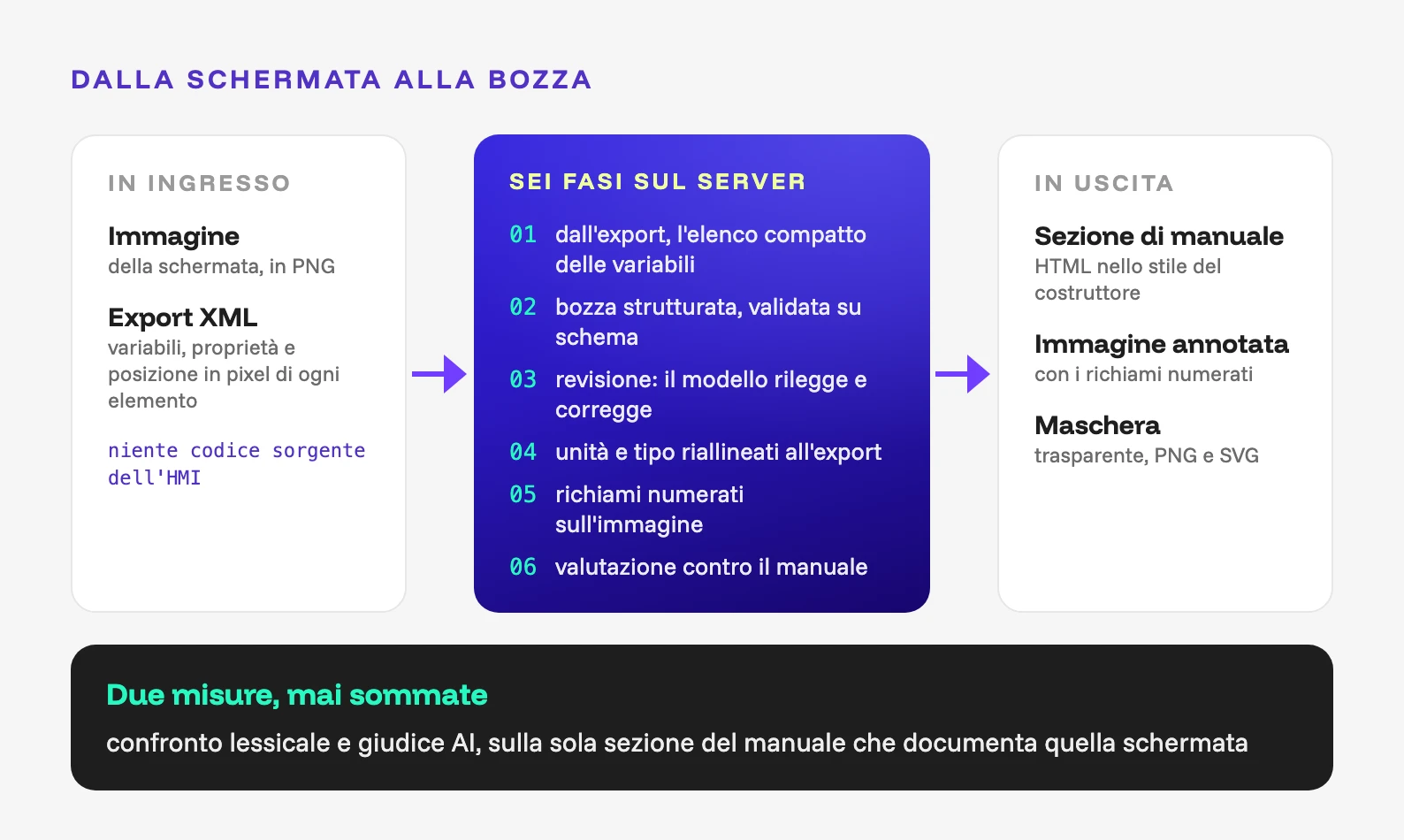
The system reads the screen and the project data, writes a first draft, rereads it on its own to correct it, and finally compares it with the manual written by the technical writers. The score is given by a second model, always the same one, so two runs weeks apart stay comparable.
What we learned by measuring
Measuring changed the way we worked. Every change, to a style rule, to the model or to how much it is allowed to reason, was tried on the test bench and kept only if the number went up. One at a time, without relying on the feeling of having made things better.
The most useful finding came from a trivial rule. On a screen with the same value repeated for the left side and the right side, the AI wrote one generic entry instead of one per side, the way the technical writers do. A single new instruction took the fields found from 13 to 41 out of 57.
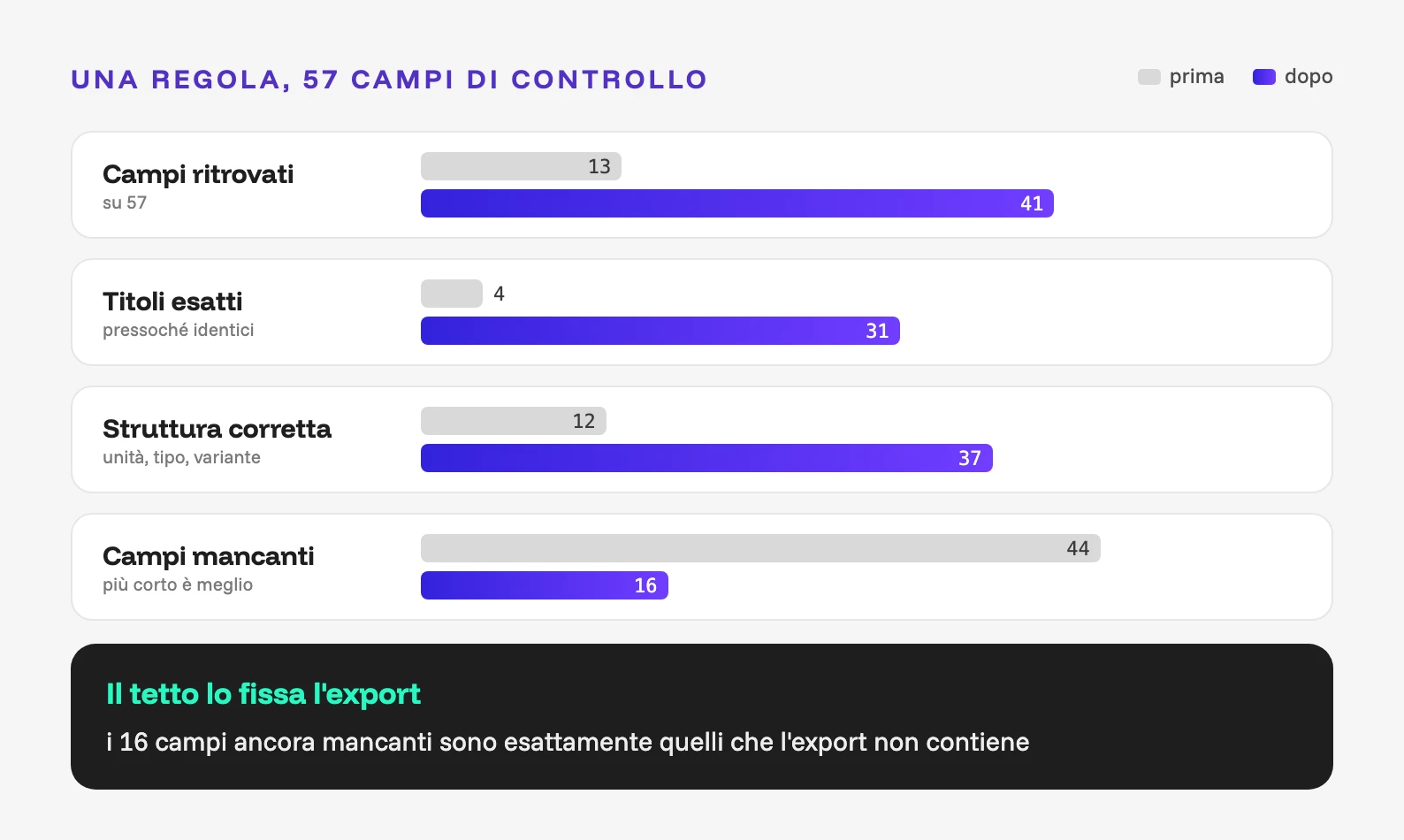
The fields still missing are exactly the ones the project file does not contain. That is the second finding, and it matters as much as the first: past a certain point the quality of the draft depends not on the model but on the data it is given. Knowing where that limit lies tells the client what to fix before going into production.
One change at a time, and only what moves the number up stays.
More than we were asked for: numbered callouts
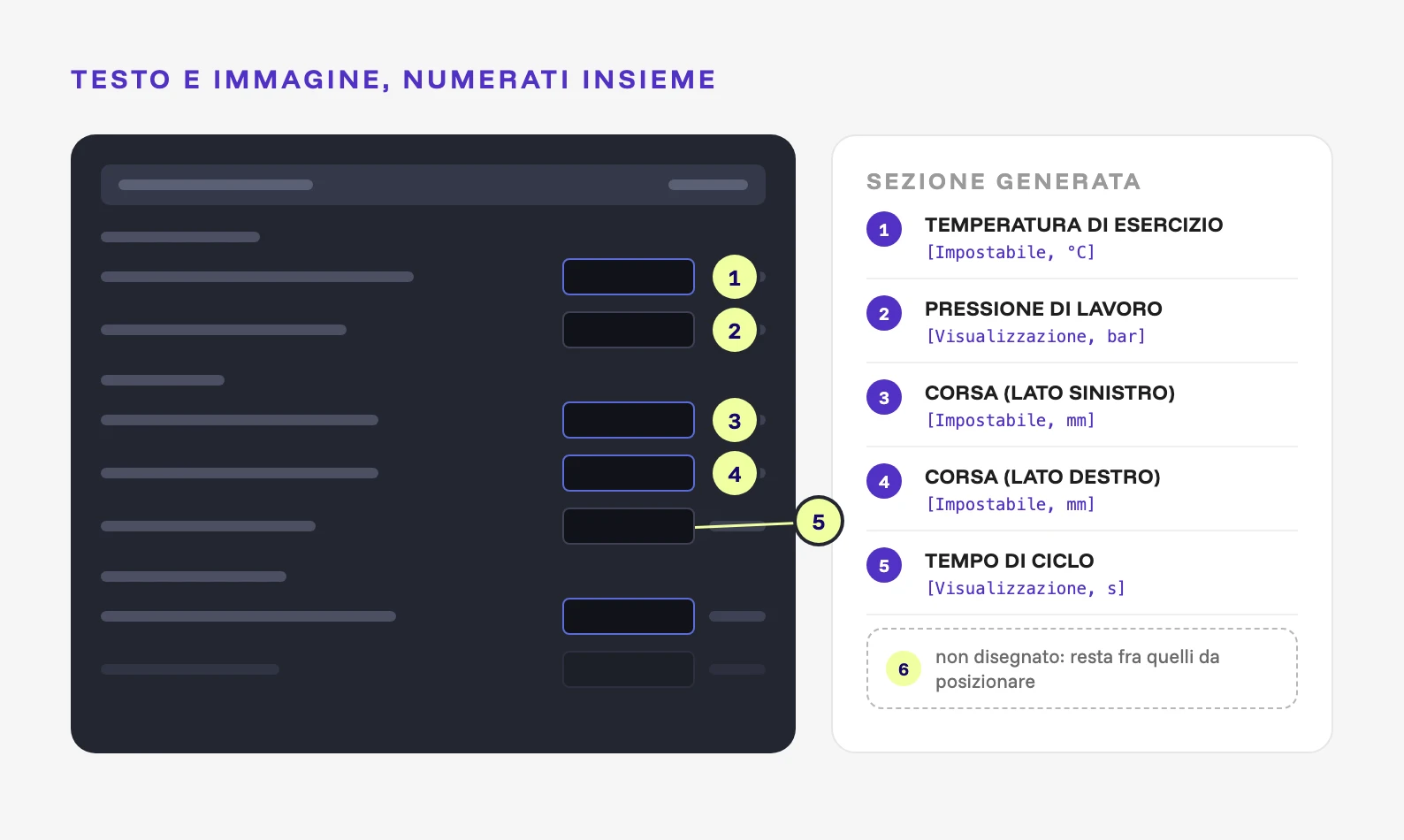
The original request was the text alone. After seeing the first results, the technical writers also asked for the image of the screen with the numbered markers that link each value to its entry in the manual, a job they do by hand today. We added it: the positions are worked out in code from the project data, not guessed by the AI, and text and image share the same numbering. Whatever the system cannot place with certainty it sets aside, ready to be fixed by hand.
What changes for technical writers
The proof of concept answered yes to the original question: starting only from the screen and the project data, AI writes manual sections that are acceptable as a draft to review. The technical writer does not disappear, the job changes: checking, correcting and adding what only someone who knows the machine knows, instead of copying titles and units by hand.
A technical manual needs a top-tier model: with smaller ones the drafts do not hold the required structure. And the limits have become concrete and fixable, such as more complete project files and higher-resolution images. On that basis the client has started building the full product.
An application in Next.js, React and TypeScript, with Claude models through the Anthropic API and structured output validated against a schema: the manual comes out as typed fields, not free text. Generation runs on the server in six phases: condensing the XML export into a compact list of variables, draft, the model's own review of its draft, realigning units and data types with the export, numbered callouts, evaluation. The comparison has two levels that are never added together, a lexical one and an AI judge with a fixed model, while units, data types and variants are checked in code. Also in code, with no model calls, the system recognises which section of the manual matches the screen: 8 correct choices and 1 declared fallback out of 9. Callouts start from the pixel coordinates in the export, verified against the image; an AI vision step corrects screens captured off-axis within 80 pixels vertically and 24 horizontally, and gives up when in doubt. PostgreSQL logs every generation with model, reasoning level, tokens, duration and scores, and makes it possible to re-score past generations with different judges without regenerating the text. In the October 2026 comparisons Opus 5.5 wrote better descriptions than Sonnet 5.5 at the same cost and duration.
Stack: Next.js, React, TypeScript, Claude API, Structured output, AI vision, LLM-as-a-judge, PostgreSQL
- Year
- 2026
- Client
- Italian industrial group, manufacturer of machinery and plants
Got something similar in mind?
Tell us what you want to build and we will help you find the shortest way there.